

A bong is a water pipe utilized to inhale cannabis. It cools vapor, ensuring a gentler, less severe pull.
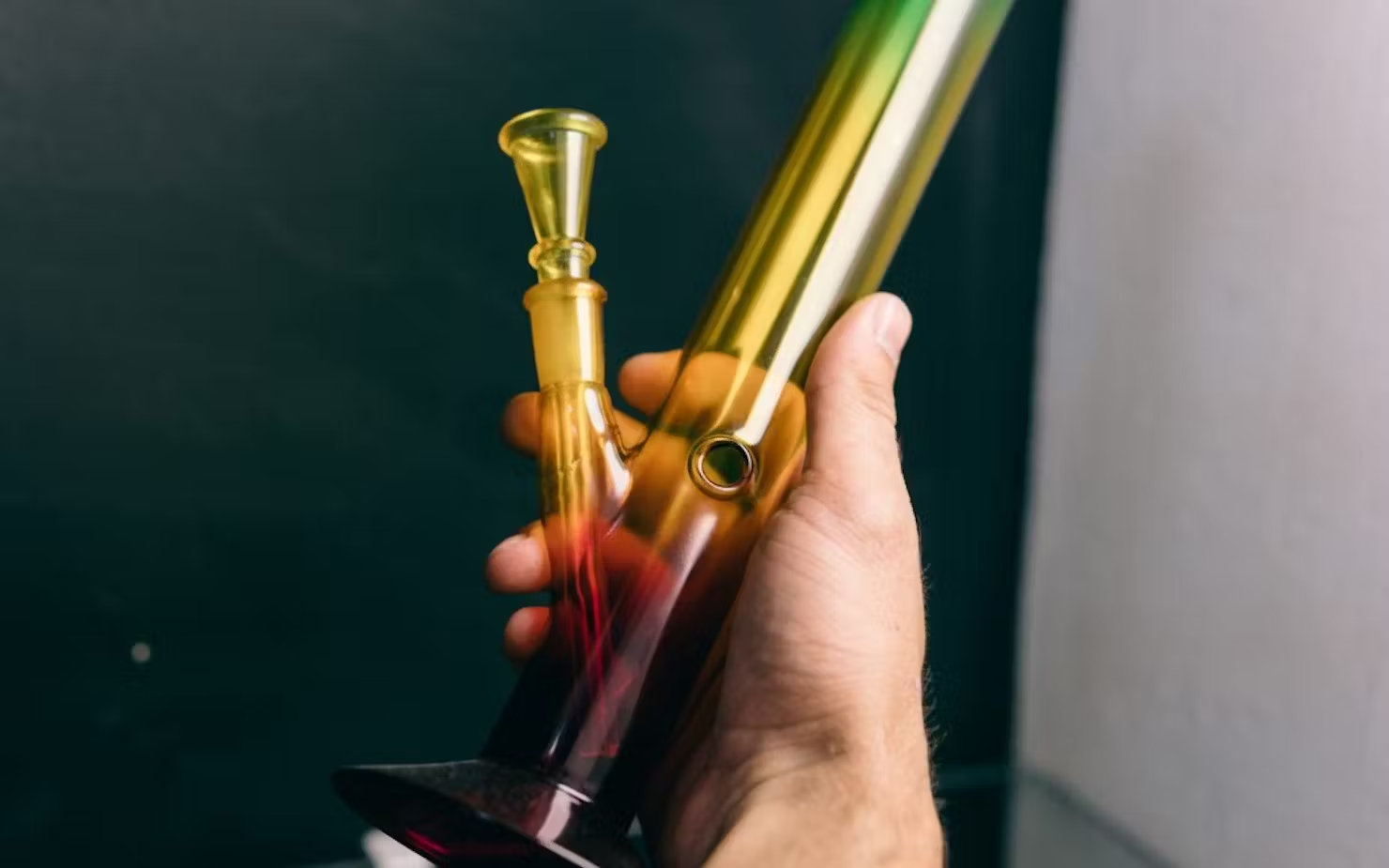
Contemporary bongs comprise a cylinder arising from a foundation. The foundation retains liquid and includes an angled opening to fit a downstem. A bowl is placed into the downstem, directing vapor down into the foundation, through a refreshing drink of liquid, before rising into the cylinder and out the mouthpiece, into the user’s lungs. The mouthpiece rests over the lips rather than into a person’s mouth.
While bongs are commonly marketed “For tobacco use only,” they arise from areas where cannabis consumption customs predate the introduction of tobacco.
Why wait in line? Enjoy the ultimate convenience of weed delivery straight to your home!
Some references indicate bongs originate in Thailand or Laos, and others argue for China and even regions of Northern Africa. Regardless of the bong’s site of origin, scholars generally concur that the bong is centuries, if not millennia ancient, and that it first gained attention in the West following the cultural exchange after the Vietnam War.
Numerous blog articles position the initial usage of the term “bong” in Western literature in a1971 edition of Marijuana Review, while others explore earlier travel writers.
The Stranger, an alternative newsweekly in Seattle, WA, attributes local glass artist Cameron Tower with creating the modern glass bong in the mid-1990s while serving as an apprentice under renowned glass creator Bob Snodgrass in Eugene, Oregon.
The piece describes a liquid-filtered hand vessel that sounds similar to what we’d term a hammer bubbler today—and though the report gained some traction, it’s a debatable piece of writing.
Countering the assertion that Tower, through Snodgrass, initiated bongs in the ‘90s, UK-based author and cannabis blogger Richard Gregory cited a July 6, 1972 edition of Rolling Stone, which features a full-page advertisement for a glass bong named “The Toker.”
Yet, it’s still uncertain who initially converted clay and wood bongs into glass.
Individuals primarily employ bongs for liquid filtration, or to cool vapor, going as far as to add ice cubes or specialized elements like frozen glycerine coils.
Others claim bong pulls elevate them higher than a typical vessel or joint because of the volume of vapor in a bong rip.
The greater the surface area of the liquid, the greater the filtration effect—which is why individuals utilize percolators. Percolators, or diffusers, amplify liquid surface area by generating small bubbles, softening large bong pulls.
By making vapor gentler on the lungs, a person can exhale more vapor in one go.
The jury is still out as to whether the liquid in a bong extracts toxins, carcinogens, and irritants from vapor. More studies need to be conducted on this.
bongs are a form of water pipe; they are upright in construction and the mouthpiece goes over your lips.
Bubblers are water pipes that feature a mouthpiece that fits between the lips. Therefore, we consider them only as water pipes and separate from bongs.
All bongs are water pipes but only some water pipes are bongs.
Like bongs, dab rigs apply liquid filtration for cannabis inhalation. The variance between the two is that a bong employs a bowl piece for igniting flower, while a dab rig has a nail, or banger, for vaporizing oil, or dabs.
Moreover, dab rigs tend to be smaller and channel vapor through multiple chambers and percolators, the vapor taking elaborate paths on the way to your mouth.
It should be mentioned that any bong can be utilized for concentrate vaporization if the bowl piece is replaced with a nail, or banger. Yet bongs aren’t optimized for concentrate inhalation and purpose-built dab rigs are advised.
bongs differ in scale, shape, functionality, and construction. Some incorporate percolators for dispersing vapor, ice catchers for chilling a hit, or constrictions that create pressure differentials and thus lower the temperature of a rip.
An increasing number of bongs veer away from practical design and are visually distinctive, colorful extravagant pieces that might fit into a home’s decor. As cannabis culture matures and incorporates larger audiences, so do our inhalation devices.
The straight cylinder is one of the most fundamental bong designs. As the term implies, it consists of a straight glass cylinder, fitted with an angled opening to accommodate a downstem.
The downstem takes a detachable bowl piece on one end and is immersed in liquid on the other, filtering vapor through cool liquid before ascending.
An ice catcher is a regular added component. Basic ice catchers are three indentations, or ice pinches, mid-way up the cylinder, meant to hold ice cubes above the liquid. Vapor travels up from the liquid and past the ice to further lessen the temperature of a hit.
The first commercial Westernized bongs were fashioned from modified scientific glass apparatus. Laboratory beakers were preferred by some for their heavy bases, making them less likely to tip over compared to straight cylinders inspired by the graduated measuring cup.
Beakers typically have a triangular foundation that transitions into a cylinder, but can become intricate with the addition of vapor-diffusing percolators, which further chill vapor, and other elements.
Percolators can take numerous forms. Some consist of just a few slits at the end of a flat-bottom downstem, while others resemble tiny chandeliers suspended inside the neck of a bong.
Today, beakers remain a favorite, as shown by the broad range of companies producing the ergonomic and efficient staple without significant modifications over the last 20 years. A design for the ages, the beaker laid the foundation for countless iterations of bongs.
The term “scientific glass” pertains to pipe-making practices that depend on science to engineer an enhanced smoking experience. This is where glassblowing expertise and science converge.
Elements like constrictions, Venturi chambers, and percolators come from the scientific glassblower’s toolkit, most of which aim to cool and filter a hit. If vapor spirals into a tiny whirlwind or circulates between multiple chambers and water features, it is the technical knowledge of a scientific glassblower you have to appreciate.
Scientific glass bongs and dab rigs have advanced the pipe-making medium in the past 20 years to create precision-made specialty items.