

Typically, it requires between 10-32 weeks, or about 3-8 months, to raise a weed plant from seed to collection. It’ll be faster if you begin with a clone or an autoflower seed.
The largest variation in how long a marijuana plant requires to develop will occur in the vegetative phase—after the seedling stage and prior to flowering.
If you’re cultivating indoors, you can compel a weed plant to bloom after just a few weeks when it’s small or after several weeks when it’s large.
When raising outdoors, you’re at the mercy of the seasons and will have to wait until the sun begins to set in the autumn for plants to bloom, and then to gather.
However, one method outdoor cultivators can manage the flowering cycle is by utilizing light deprivation techniques.
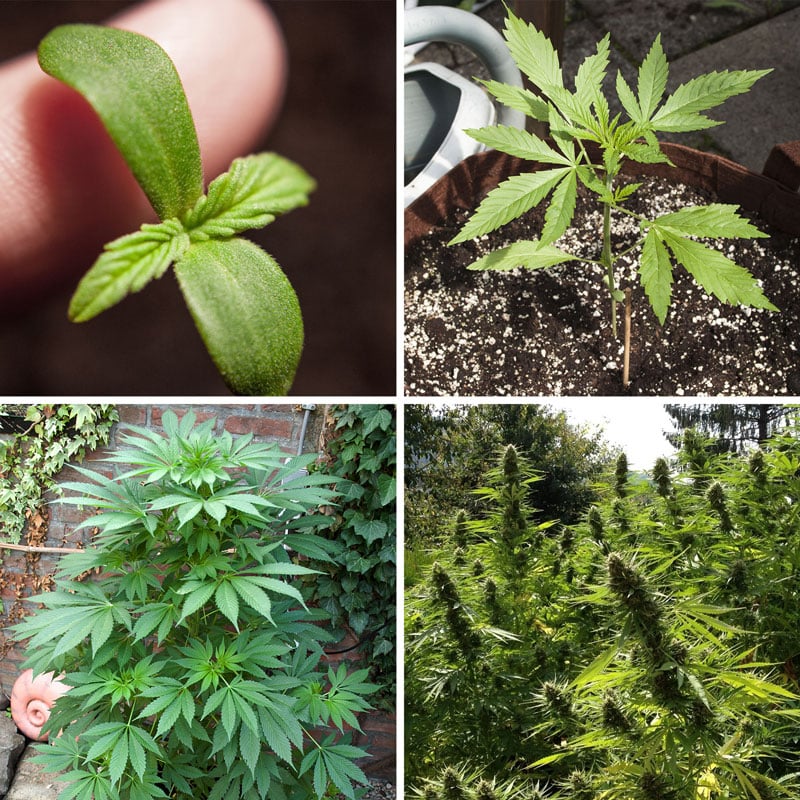
The growth phases of marijuana can be divided into four main phases from seed to collection:
marijuana seed sprouting
Seed sprouting duration: 3-10 days
Marijuana illumination cycle: 18 hours a day indoors; full, direct sun 6 hours a day outdoors
The first marijuana plant phase begins with the seed. A marijuana seed should feel solid and dry, and be light- to dark-brown in shade. An undeveloped seed is generally soft and green or white in shade and likely won’t sprout.
Once your seed has germinated, or sprouted, it’s prepared to be placed in a growing medium, like soil. The taproot will descend while the stalk of the seedling will rise.
Two rounded cotyledon leaves will expand out from the stalk as the plant unfolds from the protective shell of the seed. These initial leaves are responsible for absorbing sunlight so the plant can thrive healthy and robust.
As roots progress, the stalk will elevate and you’ll begin to see the first distinctive fan leaves expand, at which point your marijuana plant can be considered a seedling.
No. marijuana seeds are fragile and don’t appreciate being moved around. They require a warm atmosphere that doesn’t fluctuate in temperature, and not too much moisture. Once you place them in soil, we suggest leaving them alone.
High-quality seeds generally have elevated sprouting rates, but you may encounter some that don’t germinate. Let them proceed naturally; assisting them can reduce their chance of survival.
Seedling phase in marijuana plants
Seedling phase duration: 2-3 weeks
Marijuana illumination cycle: 18 hours a day indoors; full, direct sun6 hours a day outdoors
When your marijuana plant develops into a seedling, you’ll observe it forming the classic marijuana fan leaves. As a sprout, the seed will initially yield leaves with just one ridged blade.
Upon new growth appearing, the leaves will develop more blades, or “fingers” (3,5,7, etc.). An adult marijuana plant will have between 5 or 7 blades per leaf, but some plants may exhibit more.
marijuana plants are deemed seedlings until they commence developing leaves with the full quantity of blades on new fan leaves. A healthy seedling should possess a vibrant green hue.
Be cautious to not overwater the plant in its seedling phase—its roots are so petite, it doesn’t require much moisture to thrive.
At this phase, the plant is prone to illness and mold. Maintain its environment tidy and monitor for excess humidity. Be sure to provide it with ample illumination.
Even if cultivating outdoors, many growers will initiate their seeds inside under artificial lighting to assist them through this fragile phase of marijuana growth.
If you procure a clone from a grower or breeder it will be a seedling, so you can skip the seed sprouting phase.
Growth phase duration: 3-16 weeks
Marijuana illumination cycle: 18 hours a day indoors; full, direct sun6 hours a day outdoors
The vegetative phase of marijuana is when the plant’s expansion truly accelerates, and it generally persists for 3-16 weeks. At this juncture, you’ve transplanted your plant into a larger vessel and the roots and foliage are growing swiftly. This is also the period to initiate topping or training your plants.
Be aware to enhance your watering as the plant develops. When it’s young, your plant will require moisture close to the stalk, but as it matures, the roots will also expand outward, so begin watering further from the stalk in the soil so roots can stretch out and absorb moisture more effectively.
Vegetative plants appreciate rich soil with nutrients. Nourish them with a high level of nitrogen at this phase.
marijuana plant blooming phase
Blooming phase duration: 8-11 weeks
Marijuana illumination cycle: 12 hours a day indoors; full, direct sun6 hours a day outdoors
The blooming phase is the final phase of advancement for a marijuana plant. This is when plants begin to form resinous buds and your hard labor will be acknowledged. Most varieties bloom in 8-9 weeks, but some can take even longer, particularly some sativas.
Outdoors, blooming occurs naturally when the plant receives diminished illumination each day as summer transitions into autumn.
Indoor cultivators can activate the blooming cycle by decreasing the quantity of illumination marijuana plants receive from 18 to 12 hours a day.
There are three subphases of the blooming stage:
There are several alterations to contemplate once plants transition from the vegetative phase to the blooming phase:
Pre-blooms are the beginnings of marijuana plant sexual organs. If you’re cultivating regular seeds, you’ll likely have a mixture of male and female plants and will need to ascertain the gender of your plants to eliminate the males. It’s crucial to separate males so they don’t fertilize the females.
Pre-blooms emerge at the nodes of the plant, where a branch grows out of the primary stalk. Females will form an oval-shaped bract with hairs or pistils protruding, while males will form round pollen sacs.
When raising outdoors, weed plants will begin blooming, or flowering, after the summer solstice, when the daily illumination amount starts to diminish. plants will start producing pre-blooms, as noted above, indicating that blooming has commenced.
When growing indoors, cultivators decide to compel flowering or “flip” plants into bloom by reducing the amount of artificial illumination they receive.
What to do when marijuana plants bloom early or late
The duration it takes an plant to finish, or be done blooming and ready for gathering, will depend on what variety it is. Typically, indicas finish blooming early and sativas finish blooming late.
Note details from the breeder when you purchase seeds to cultivate to gain an understanding of how long it requires to bloom. You may need to gather some plants early and some late depending on their maturation times.
For late-blooming varieties, monitor the climate and ensure cool weather doesn’t damage your plants before they complete.
When do buds develop the most?
Buds typically expand the most toward the conclusion of the blooming life cycle. You probably won’t perceive much budding at the start of the blooming phase, and it will decelerate toward the end of the cycle, when buds become fully developed.
Once buds have attained full maturation, it’s time to gather your marijuana. How long it takes to collect buds hinges on various factors, including collecting methods and how many plants you harvest.
Weed plants are perennials, meaning they grow and exist for one season and then perish. Wild marijuana plants generate seeds and drop them when they perish, which will sprout into new plants the following year.
When harvesting, plants are severed and perish in order to retrieve their buds. New seeds need to be sown in order to cultivate more plants.
If left unharvested, weed plants will ultimately wither and decay within a few months after the peak blooming phase.